Ugh. I never thought it could happen but it did: I had a Bad Yarn Store experience. I've recently moved to a small suburb southwest of Boston and haven't been yarn-shopping here yet; usually I visit a store first, just to browse, familairize myself with the options, and--most impotantly--to see if its the kind of place I feel comfortable giving my money too. But I really needed sock yarn for Xmas presents, so I thought "what the hell" and went for it.
My first impression? Small. Small and messy. Now, small is not necessarily a problem--in high-population areas space is at a premium, and I've been to some yarn stores where small=cozy [Halifax, NS]. As for messy, people who live in glass houses should learn to live with stangers looking at their underwear. Or something. So I begin my meander--quick past the novelty yarns I have no interest in, slow past natural fibers (ok, that takes care of two of the three walls)--and soon find myself in front of the sock yarn, negotiating a little for space with a woman, her stroller, and a cute little girl who is obviously not a knitter, and impatient. There is a lot of sock yarn. Good! Half the skeins don't have ball bands. Bad! It's ok, I'm looking for 100g balls of Regia self-striping wool/nylon, which is not too hard to spot.
My first real twinge comes with the huffing of two older women waiting at the register. They're not getting service, not yelling "dude, I need service" (dirty!), and not happy about it. Clearly there needs to be a bell. They eventually tear a woman I assume is the shop-owner away from the knitting group table. Oh? I didn't mention that half the space in the store was filled by a big table and assorted knitters? It was. The ladies make their purchases while I finish comparing colors and grab a set of DPNs (my other set is in some other socks) and get in line behind another customer, who is buying Patons yarn.
I wait. And wait some more because the only thing computerized at the "register" is the credit card swiper (and I'm sure that if Visa would allow it, that would be gone too). The "register" is a calculater and a pad of paper. Still, I am thinking good thoughts because I know it is very hard for old people to get help with the technology. It might have helped if the counter hadn't been buried in miscellaneous papers, books, and lotion displays--at the very least it would have prevented the woman's yarn from rolling onto the floor every five seconds. I make chitchat with the "register" lady and the customer about my sock yarn, which I am making up for my grandmother. Isn't that nice?
Then I discover the power of becoming invisible.
During the ten minutes it has taken for the purchase of four skeins of Patons wool/acrylic, Woman-with-stroller-and-child (WWSAC) has made her decision and come into the line. The "register" lady has asked WWSAC about her sister, and when she finishes sending the Patons into the world, asks WWSAC, "Are you in a hurry?" Why yes, yes she is; the little girl is starting to yell and she has to meet someone... Well then, "register" lady will just ring her up quick.
Neither of them look at me, standing with my Regia and needles. They chat about a difficult pattern WWSAC has been knitting. I want to throw the yarn on the ground and walk off, but I can't--too polite, or too scared.
Suddenly, all those little negatives I noticed before and brushed off come roaring back, ten times their original size. I didn't mind waiting; I had no place to be; I absolutely want to keep small children from having tantrums in small stores--but I was shocked and hurt by the breach of what I consider common courtesy. Acknowledgement is the very least we owe other people; I felt like a non-entity. Later, I tried to decide: Was it because I was a newcomer? The other women had obviously known each other a while. Maybe because my purchase was small: socks are not sweaters. But I think it was because I am young and I said the yarn was a gift. They saw me and didn't hear "gift I am making"--they heard "not a knitter." As everyone knows from the newspaper, young knitters buy novelty yarns to make fashion scarves. Except that I don't have to: my grandmother has knit over 80 of those this year, which frees up my time for knitting lace shawls, cabled sweaters. And socks.
I hope WWSAC calmed her daughter down and made it to her appointment on time--I won't know, though, because I'm never going near that yarn store again.
Showing posts with label knitting. Show all posts
Showing posts with label knitting. Show all posts
12.09.2005

8.01.2005
Woodworking
I was given a whole heaping load of old Spin-Offs recently by the very generous lady who taught me to spin; I've started working my way through them (almost done with the 2000s!), but it's taking me rather a long time, not only because I like to read each magazine deliberately, cover-to-cover, but also because they keep inspiring me to go off and make things. Mostly it's yarn--I've been dying hand-combed rovings with food-coloring, spices, and other natural dyes as described in various articles:
But I have also been inspired to make for myself a few of the little tools I've been missing. Now, I could have bought both of these at the yarn store, but I am both poor andcheap thrifty and so I decided to make a WPI gauge: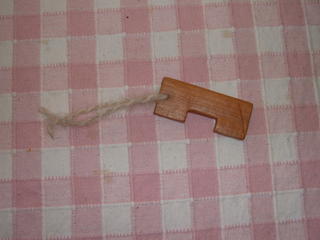
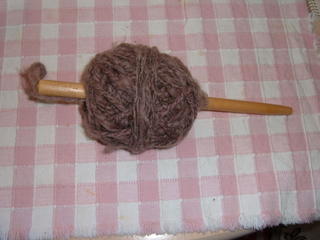
Ok, yes, I used a little creative liscence on the nostepinne: it's really just a tapered dowel that I found in the junk pile of the barn, cut to 10", and sanded (plus the notch in the end). I've never seen one in real life, but I think mine is a lot bigger than nostepinnes usually are--I wrapped some singles off on it, but made more of a center-pull tube than a center-pull ball. It was like plying from a catepillar. Worked well on the chunky handspun you see in the picture though.
The WPI (wraps per inch) gauge is more interesting. I've been wanting one ever since I watched a Mabel Ross video that explained how to actually use it. I also got the wood for this from barn scraps, but it took me a lot longer to actually come up with something I liked. I only have handtools, no power (except a drill): a hacksaw, a pocket knife, and sandpaper. I made about four prototypes of the gauge before I settled on the one above. The first wood I used was too soft and kept flaking. The second was a little better, but also would split when carved. The third I used a piece of leftover moulding, which was easy to carve, but was too big around to be effective for thin yarn--took way too much yardage to get enough wraps. The fourth time I fixed the wood problem, with the reddish-hardwood I ended up with, but I initially tried to put the cut-out along the cut edge of the wood, perpendicular to the grain. Impossible. Then, kind of frustrated, I whipped out the hacksaw and sliced a 3x2 inch piece out of the original 2x4, then cut that in half, ending with a 1x3x2 inch piece of wood. After that it was kind of a breeze to carve out the middle inch and whittle and sand the piece square (or, rectangular). I used a 11/64" drill bit for the hole, finished it up with a couple of coats of Johnson's paste wax (the finish I use for all my wood spinning supplies), and a length of handspun (dog hair from my German Shepherd). Ta-da!

(clockwise from top left: food coloring, food coloring and turmeric, black tea and coffee, marigolds)
But I have also been inspired to make for myself a few of the little tools I've been missing. Now, I could have bought both of these at the yarn store, but I am both poor and

and a nostepinne:
Ok, yes, I used a little creative liscence on the nostepinne: it's really just a tapered dowel that I found in the junk pile of the barn, cut to 10", and sanded (plus the notch in the end). I've never seen one in real life, but I think mine is a lot bigger than nostepinnes usually are--I wrapped some singles off on it, but made more of a center-pull tube than a center-pull ball. It was like plying from a catepillar. Worked well on the chunky handspun you see in the picture though.
The WPI (wraps per inch) gauge is more interesting. I've been wanting one ever since I watched a Mabel Ross video that explained how to actually use it. I also got the wood for this from barn scraps, but it took me a lot longer to actually come up with something I liked. I only have handtools, no power (except a drill): a hacksaw, a pocket knife, and sandpaper. I made about four prototypes of the gauge before I settled on the one above. The first wood I used was too soft and kept flaking. The second was a little better, but also would split when carved. The third I used a piece of leftover moulding, which was easy to carve, but was too big around to be effective for thin yarn--took way too much yardage to get enough wraps. The fourth time I fixed the wood problem, with the reddish-hardwood I ended up with, but I initially tried to put the cut-out along the cut edge of the wood, perpendicular to the grain. Impossible. Then, kind of frustrated, I whipped out the hacksaw and sliced a 3x2 inch piece out of the original 2x4, then cut that in half, ending with a 1x3x2 inch piece of wood. After that it was kind of a breeze to carve out the middle inch and whittle and sand the piece square (or, rectangular). I used a 11/64" drill bit for the hole, finished it up with a couple of coats of Johnson's paste wax (the finish I use for all my wood spinning supplies), and a length of handspun (dog hair from my German Shepherd). Ta-da!
I'm really happy with the way it turned out. It's not 100% even, but I kind-of like that it has a rustic quality. Like they say on Antiques Roadshow: you can see the tool-marks, proves it's original. Also, I feel super crafty. Being a knitter and handspinner I should totally be blase about making stuff, but every time I'm surprised by how wonderful it is to make things with one's own hands.
7.15.2005
The Opinionated Knitter
I've been a fan of Elizabeth Zimmerman since I was astounded by the usefulness and charm of Knitter's Almanac--a book I bought less because of name recognition (although I did--you don't poke around in the knitting world for long without hearing her name) than because it was the cheapest knitting book I could find that got me free shipping on my Amazon order. Imagine my surprise when a little paperback comes out of the box with that wonderful cover and my utter delight at what a wonderful read it was, above and beyond the practical, beautiful patterns. Well, it was enough to put me on EZ's multitudinous fan list, and though I haven't bought any of her other books (rarely do I make such impulsive purchases as the aforesaid, in part because they rarely turn out this well) I watch eagerly for when they show up in my local library.
I had heard about The Opinionated Knitter, which collects EZ's newsletters from 1958-1968, somewhere on the knitting internet (the knitternet?), so when I saw it on the library shelf I snatched it up with great enthusiasm. That enthusiasm was rewarded. Not only has Meg Swanson collected the newsletters themselves, she has interspersed them with pictures of the projects (some of which were published at the time in mainstream knitting magazines, but with the somewhat incoherent, flat-construction directions which prompted EZ to begin the newsletter in the first place), her own comments and clarifications and annotations on the patterns, and excerpts from EZ's writing in other places (e.g. her journals). The patterns themselves, because they are photographic copies of the original hand-typed newsletters, are somewhat hard to read. If I wanted to knit one, I might choose to re-type (or enlarge on photocopy) the pattern with clearer spacing. On the other hand, EZ's patterns tend to be simple (not in concept, but in language--she writes her patterns not in bullet-points, but in prose, so that a direction for an aran cap, say, will contain a line such as, "You will find that Things Happen every 6th rnd; in between you can relax," which is about as accurate a description of the cabling process as I've ever heard) and moreover her design process (Elizabeth's Percentage System, or EPS, in its various stages) invites--and on occasion demands--the knitter to stray from the pattern and become a designer as well, so perhaps the "improvement" wouldn't be necessary after all.
So I was going along, taking my time and enjoying the view (knitting books are better consumed slowly) when my mother, who doesn't knit, picked up the book and flipped through it. She stopped on a page with a picture of EZ's journal (and the typed transcription of same) from a camping trip she and "Gaffer" (and their cat) took while she was working on Knitter's Almanac. Mom laughed an scoffed and read aloud this passage:
The last part, clearly is my mother's contributory comment.
I, with my usual cutting wit, looked at her in shock, mouth agape, then said, "Well...knitters!" Unexpectedly, I knew I'd hit on something--it made me think about the way EZ's influence has worked on the knitting world. Even though she grew up and learned to knit pre-WWII, in a time when handknitting was still mostly necessity, her writing never treats knitting as anything less than a marvel, an artisanal craft, and a passion. The audience for EZ's work is never "people who knit", or "housewives", or "consumers", but always Knitters as a category of human beings with their own needs and lives and creative will.
You'll often hear comments about EZ's books (particularly Knitting Without Tears) that go along the lines of "Elizabeth...gave me a sense of being able to believe that most things in knitting--and life too--happen in ways that are open to an inquiring brain. Perhaps that sounds too dramatic, but I know that what I learned from her changed me for the better in every way I can understand it." This quote, which I took from the end of the book, is one of many excerpted from letters sent to the Zimmermans after EZ's death in 1999. Her work touched people in a very personal way; we are interested in her writing, like the above passage than failed to thrill my mother and the discussion of the overrated evils of pilling that follows it, because it feels like she would be interested in us. Not because her experiences are novel and thrilling (although some of them were), but because she talks to the knitter-reader as a peer, a person with a shared love of knitting and shared experience.
(As I type this, I have a cat who has eschewed two beds, several armchairs, a couch, and a sun-lit carpet in favor of sleeping on a half-finished afghan with a circ needle and a crochet hook sticking out of it.)
The Opinionated Knitter is record of the history of modern knitting--love it or loathe it, it wouldn't have been nearly as much fun without Elizabeth Zimmerman.
I had heard about The Opinionated Knitter, which collects EZ's newsletters from 1958-1968, somewhere on the knitting internet (the knitternet?), so when I saw it on the library shelf I snatched it up with great enthusiasm. That enthusiasm was rewarded. Not only has Meg Swanson collected the newsletters themselves, she has interspersed them with pictures of the projects (some of which were published at the time in mainstream knitting magazines, but with the somewhat incoherent, flat-construction directions which prompted EZ to begin the newsletter in the first place), her own comments and clarifications and annotations on the patterns, and excerpts from EZ's writing in other places (e.g. her journals). The patterns themselves, because they are photographic copies of the original hand-typed newsletters, are somewhat hard to read. If I wanted to knit one, I might choose to re-type (or enlarge on photocopy) the pattern with clearer spacing. On the other hand, EZ's patterns tend to be simple (not in concept, but in language--she writes her patterns not in bullet-points, but in prose, so that a direction for an aran cap, say, will contain a line such as, "You will find that Things Happen every 6th rnd; in between you can relax," which is about as accurate a description of the cabling process as I've ever heard) and moreover her design process (Elizabeth's Percentage System, or EPS, in its various stages) invites--and on occasion demands--the knitter to stray from the pattern and become a designer as well, so perhaps the "improvement" wouldn't be necessary after all.
So I was going along, taking my time and enjoying the view (knitting books are better consumed slowly) when my mother, who doesn't knit, picked up the book and flipped through it. She stopped on a page with a picture of EZ's journal (and the typed transcription of same) from a camping trip she and "Gaffer" (and their cat) took while she was working on Knitter's Almanac. Mom laughed an scoffed and read aloud this passage:
"KLINE [the cat] and I have abandoned the campfire to its
spitting and hissing fate, along with a pot of coffee-water, hopefully suspended over it, and have retired to the tent. He kneads himself a bed on my heavy camp sweater, which he prefers to all the Hudson's Bay blankets and down jackets offered to him. I don't blame him; it is made of beautiful old dark Oatmeal Sheepsdown with a natty Tyrolese border of Loden green and black. Over the years it has lengthened to a 3/4 coat and it is the sweater which had it's pockets removed and re-inserted much higher up. Blah, blah, blah, who cares?"
The last part, clearly is my mother's contributory comment.
I, with my usual cutting wit, looked at her in shock, mouth agape, then said, "Well...knitters!" Unexpectedly, I knew I'd hit on something--it made me think about the way EZ's influence has worked on the knitting world. Even though she grew up and learned to knit pre-WWII, in a time when handknitting was still mostly necessity, her writing never treats knitting as anything less than a marvel, an artisanal craft, and a passion. The audience for EZ's work is never "people who knit", or "housewives", or "consumers", but always Knitters as a category of human beings with their own needs and lives and creative will.
You'll often hear comments about EZ's books (particularly Knitting Without Tears) that go along the lines of "Elizabeth...gave me a sense of being able to believe that most things in knitting--and life too--happen in ways that are open to an inquiring brain. Perhaps that sounds too dramatic, but I know that what I learned from her changed me for the better in every way I can understand it." This quote, which I took from the end of the book, is one of many excerpted from letters sent to the Zimmermans after EZ's death in 1999. Her work touched people in a very personal way; we are interested in her writing, like the above passage than failed to thrill my mother and the discussion of the overrated evils of pilling that follows it, because it feels like she would be interested in us. Not because her experiences are novel and thrilling (although some of them were), but because she talks to the knitter-reader as a peer, a person with a shared love of knitting and shared experience.
(As I type this, I have a cat who has eschewed two beds, several armchairs, a couch, and a sun-lit carpet in favor of sleeping on a half-finished afghan with a circ needle and a crochet hook sticking out of it.)
The Opinionated Knitter is record of the history of modern knitting--love it or loathe it, it wouldn't have been nearly as much fun without Elizabeth Zimmerman.
Subscribe to:
Posts (Atom)